Teaching a Card Game to Take Turns
The January 2015 Spades history records bidding, scoring, AI work, and a shift from frame-by-frame updates to explicit game state.
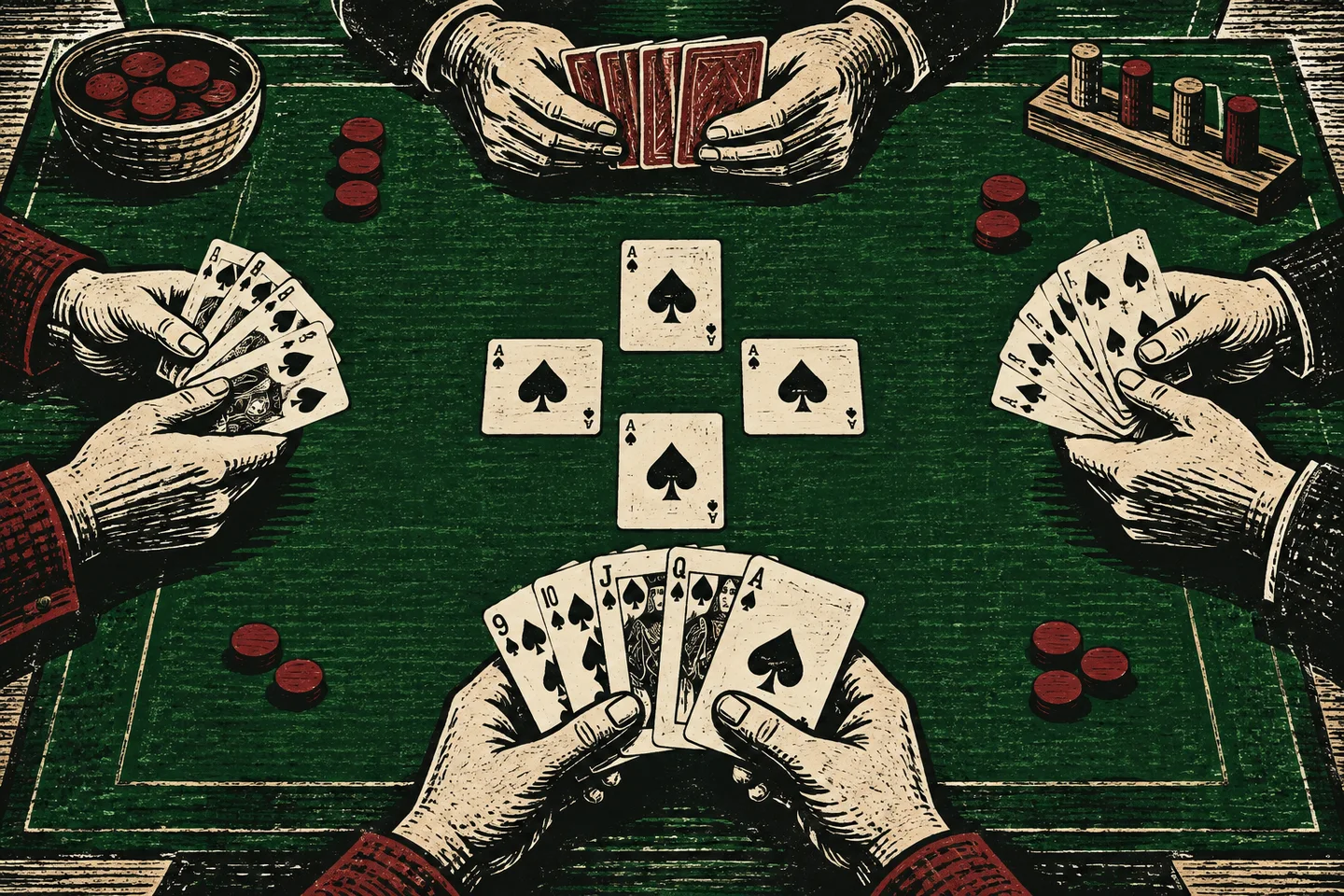
Spades looks straightforward when people play it. Everyone knows whose turn it is, what counts as a legal play, and when to collect a trick. Programming it means making all of that explicit.
My January 2015 Bitbucket project captures that work in unusually helpful commit messages: AI updates, bidding and scoring, a fix to trick order, restoring the human player, and finally a scoreboard laid out as a grid.
A card game does not need to think every frame
One January 26 commit is the part I most want to preserve. I restructured the game manager to use coroutines and game state instead of Update, because the game did not need updates every frame.
That is a useful little design lesson. The engine offers a continuous loop, but a turn-based game progresses through decisions and events. Modeling the turn directly can be easier to reason about than repeatedly asking whether something should happen.
The archive also includes a test project. There is a collaborator’s commit in the history, so this was not exclusively my work; the milestones described here are from commits attributed to me.
Before the deckbuilders
This project predates the later experiments with co-op deckbuilding and Unity ECS card-game code. It is an earlier encounter with the same underlying challenge: translating familiar tabletop behavior into precise software state.
The January 31 scoreboard commit anchors this entry. It is evidence of development progress, not a claim that I shipped a finished Spades game.
From the Bitbucket archive. Written in September 2026 from private repository history and recollection; the date above marks project work, not original publication. Cover art is a conceptual illustration. Private source code is not reproduced.